
The village that never sleeps hides a ghostly lullaby, a haunted forest, and a tragic secret waiting to be revealed.
The village that never sleeps stood at the end of a road most travellers never found twice. Nandipur was hidden beyond dry fields, a shallow river, and a forest so dense that sunlight seemed reluctant to enter it. During the day, however, it looked like any other quiet village: children chased each other through narrow lanes, cattle rested beside mud-brick homes, and smoke drifted from kitchen fires.
Yet as sunset approached, Nandipur changed.
One by one, lamps appeared in every window. Doors were bolted, but nobody went inside. Mothers gathered their children close, fathers carried stools onto their porches, and the tea seller prepared enough strong tea to keep the whole village awake.
No bed was made.
No lullaby was sung.
No lamp was allowed to die.
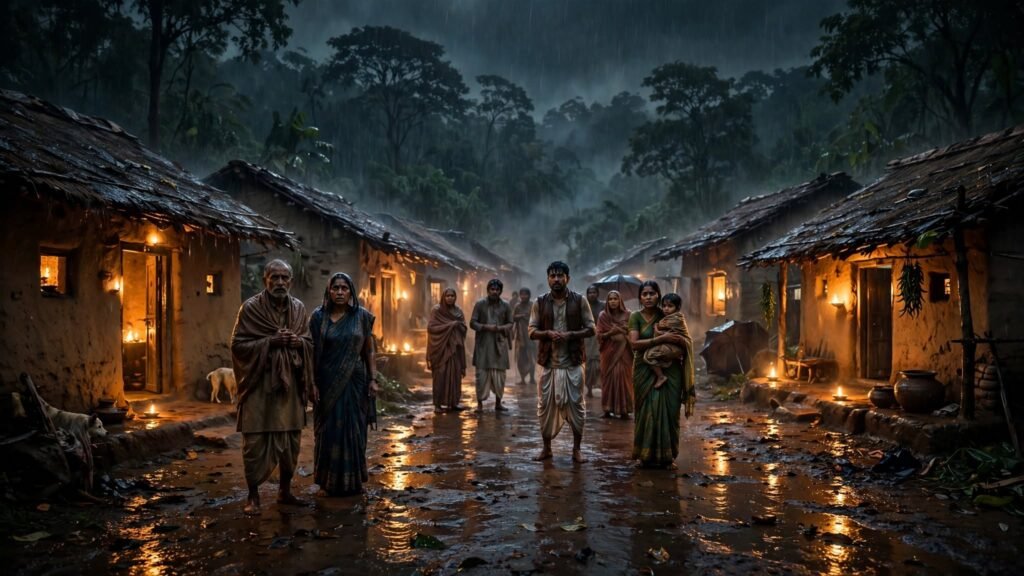
The Road to Nandipur
A Warning at the Railway Station
Arjun Mehta first heard of Nandipur at a small railway station outside Lucknow. He was a journalist who wrote about forgotten places, village legends, and the stories people told only after checking that no stranger stood nearby.
That afternoon, rain delayed his train. While he waited beneath the station roof, an elderly schoolteacher sat beside him on a wooden bench.
“You write stories?” the old man asked, noticing Arjun’s notebook.
“I do,” Arjun replied. “Mostly about places people have forgotten.”
The teacher looked toward the darkening sky.
“Then write about Nandipur.”
Arjun smiled. “What is special about it?”
For several seconds, the teacher said nothing. Finally, he leaned closer.
“It is the village that never sleeps.”
Arjun assumed he meant a festival, perhaps a yearly vigil or a temple ceremony. “Only during certain nights?”
“Every night,” the teacher said.
“Why?”
At that, the old man’s face tightened. “Because there is a woman in the forest who sings to the children.”
Before Arjun could ask another question, the train whistle sounded. The teacher rose, collected his cloth bag, and disappeared into the crowd.
Nevertheless, the words stayed with Arjun long after the train had left the station.
Arrival Before Sundown
Two days later, Arjun hired a jeep and set out for Nandipur. His driver, Rafiq, agreed to take him there only after making one condition.
“I will leave before dark,” Rafiq said.
“Why?” Arjun asked.
Rafiq kept both hands tightly on the steering wheel. “Because I prefer to sleep at night.”
The paved road ended after three hours. Soon afterward, the jeep travelled along a path of loose stones and cracked mud. Tall grass brushed against the doors, while the forest watched from the horizon like a wall of black-green shadows.
By late afternoon, they reached a faded wooden sign.
NANDIPUR — POPULATION: 417
Beneath the fresh paint, Arjun saw the ghost of an earlier number.
618
“What happened to the others?” he asked.
Rafiq looked away. “Ask the village head.”
Then, without waiting for a reply, the driver placed Arjun’s bag on the roadside and turned the jeep around.
As the vehicle vanished, the first lamp in Nandipur was lit.
A Village of Open Eyes
Lamps Before Nightfall
The village lanes were unusually quiet when Arjun arrived. A few children watched from doorways, although their parents quickly pulled them inside. Meanwhile, an elderly woman at the hand pump stopped filling her brass pot and stared at him with open suspicion.
Near the banyan tree, a tea seller served customers in silence.
Arjun approached a tall, white-haired man seated beneath the tree. His plain kurta was neatly pressed, and his expression carried the weary authority of someone accustomed to bad news.
“I am looking for the village head,” Arjun said.
“I am Devendra Singh,” the man replied.
Arjun introduced himself and explained that he hoped to stay for one night.
Devendra’s eyes narrowed. “Visitors should not remain here after sunset.”
“I am a journalist,” Arjun said. “I only want to understand the story.”
“Some stories are safer when they are not understood.”
Still, after a long pause, Devendra led him to an empty house near the village boundary. The room contained a woven cot, a brass lamp, and a small window facing the forest.
“You may stay here,” Devendra said. “However, do not leave after midnight.”
“What happens after midnight?”
The old man’s hand paused on the doorframe.
“After midnight,” he said quietly, “the village remembers.”
The Midnight Vigil
At first, Arjun thought the villagers were simply cautious. However, as darkness settled, their behaviour became stranger.
By eight o’clock, every home was brightly lit. By nine, chairs and charpoys had been carried into the lanes. By ten, even the smallest children had been awakened and given cups of sweet tea.
No one lay down.
No one closed their eyes for long.
Instead, every family faced the forest.
Arjun filled page after page in his notebook. He wrote about the lights, the silence, and the way even the dogs refused to bark. Yet no description captured the feeling of Nandipur after dark.
It was not merely wakefulness.
It was waiting.
At eleven forty-five, the temple bell began to ring.
Once.
Twice.
Then, slowly, twelve times.
The sound spread across the lanes and fields. As a result, every conversation stopped at once.

The First Bell
A Lullaby from the Forest
Arjun stepped outside despite Devendra’s warning. Rain had begun to fall, soft at first and then steadily harder. Around him, villagers stood under umbrellas, shawls, and cloth coverings, yet nobody looked at the weather.
All eyes faced the trees.
For a moment, Arjun heard nothing except rain striking the mud road.
Then a voice rose from the forest.
It was a woman’s voice.
The tune was gentle, almost beautiful. It sounded like the kind of lullaby a mother might sing beside a sleeping child. However, beneath its sweetness ran a note of unbearable sadness.
“Come home,” the song seemed to whisper.
“Come home, little one.”
A woman in a red shawl gasped. She stood near the far end of the lane, holding the hand of a little girl in a yellow dress.
“Riya,” the woman pleaded. “Do not listen.”
The child’s face softened.
Then she let go of her mother’s hand.
Riya Walks Away
Riya began walking toward the fields.
Her father rushed forward, but Devendra and two other men held him back. “Do not shout her name,” Devendra warned. “You will make her follow faster.”
Arjun could not understand it. The girl was only seven or eight years old, barefoot in the rain and moving with the calm purpose of someone walking home after school.
Meanwhile, the lullaby grew louder.
Riya crossed the lane and reached the edge of the field. Without thinking, Arjun ran after her.
“Stop!” Devendra shouted.
Nevertheless, Arjun kept moving.
Mud splashed around his shoes as he caught up with the child. He reached for her wrist, but she turned before he could touch her.
Her eyes were open.
They were not focused on him.
Instead, she stared at something over his shoulder.
A cold wind passed through the field.
Slowly, Arjun turned around.
The Woman in the Rain
Sushila’s Return
At the edge of the forest stood a woman in a white sari.
Rain soaked the cloth until it clung to her thin frame. Long black hair hung across one side of her face. In her arms, she carried a small bundle wrapped in faded fabric.
Arjun wanted to run, but his feet would not move.
The woman lifted her head.
Her face looked young, although her eyes seemed impossibly old.
“Why are you awake?” she asked.
Her voice was the same voice from the lullaby.
Arjun tried to answer, but fear had dried his throat.
The woman looked past him toward the village, where hundreds of lamps burned through the rain.
“They are all awake,” she whispered. “Still afraid.”
Riya took another step forward.
This time, Arjun grabbed her hand.
The woman’s gaze returned to him. “You are not from here.”
“No,” he managed.
“Then you do not know what they did.”
A Question Without an Answer
The woman lowered her eyes to the bundle in her arms.
“My name was Sushila,” she said.
At that instant, the wind tore across the fields. Lamps flickered in the village. The temple bell began ringing wildly, although no one stood near it.
“What did they do?” Arjun asked.
Sushila’s mouth trembled.
“They took my son from his home.”
The rain fell harder.
Before Arjun could speak again, she vanished.
There was no flash of light or drifting smoke. One moment she stood before them; the next, the forest edge was empty.
Riya collapsed into Arjun’s arms.
Across the field, villagers rushed forward. The woman in the red shawl—Riya’s mother—clutched the child and began to cry.
Devendra arrived last.
His face had gone pale.
“Sushila,” Arjun said. “Who was she?”
The old man looked toward the forest. Then he looked at the terrified villagers surrounding him.
Finally, he said, “She was the reason we do not sleep.”
The Secret Beneath the Banyan Tree
Mohan and the Fire
By morning, Nandipur looked ordinary again. Sunlight dried the muddy lanes, roosters crowed from rooftops, and smoke rose from cooking fires. Yet beneath that ordinary surface, the village felt exhausted.
Arjun found Devendra sitting beneath the banyan tree.
“You saw her,” Devendra said.
“Yes.”
“Then leave while you can.”
“I will leave after you tell me the truth.”
For a long while, Devendra stared at the tree roots. Eventually, he began.
“Thirty years ago, Sushila lived in the house where you stayed. She was a widow, and she had one son named Mohan.”
“What happened to them?”
“A fever came to Nandipur,” Devendra said. “Children became ill. Three died within a week. People were frightened, and frightened people often search for someone to blame.”
Arjun felt a knot form in his stomach.
“They blamed Sushila?”
“They called her cursed. Her husband had died young. Mohan was sick. Some people said misfortune followed her family.”
“That is not a reason to hurt someone.”
“No,” Devendra replied. “But fear does not need reason.”
One night, several villagers came to Sushila’s house. They told her she had to leave before dawn. Mohan was sleeping inside with fever.
“Then the house caught fire,” Devendra said.
Arjun stared at him. “Caught fire?”
“Some claimed it was an accident. Others said lightning struck the roof. However, there was no storm that night.”
Thirty Years of Fear
Sushila returned from the well when she saw flames rising from her home. She tried to run inside, but the villagers held her back.
“Mohan was calling for her,” Devendra continued. “We all heard him.”
His voice broke.
“Did anyone save him?” Arjun asked.
Devendra shook his head.
“No one.”
At dawn, Sushila carried Mohan’s body beneath the banyan tree. She sat there until sunset, singing the lullaby she used to sing when he was afraid.
Then she walked into the forest.
Three nights later, the first child disappeared.
The boy was found at dawn beneath the banyan tree. He was alive, but he never spoke again. After that, other children began following the song. Some returned. Others vanished forever.
“So everyone stayed awake,” Arjun said.
“Every night,” Devendra replied. “We believed our fear kept her away.”
Arjun looked at the bright morning sky.
“No,” he said. “Your fear kept her here.”

The Price of Staying Awake
What the Villagers Lost
During the following day, Arjun spoke with people throughout Nandipur. At first, most refused to answer. However, once Devendra’s confession began to spread, silence became harder to maintain.
A shopkeeper admitted that his younger brother had heard Sushila’s lullaby at age ten. The boy returned two days later with mud under his fingernails and white streaks in his hair.
An old woman confessed that she had held Sushila’s arms while the house burned.
Meera, Riya’s mother, revealed that her daughter had begun humming the lullaby in her sleep.
Because of the curse, Nandipur had lost more than its missing children. Families had lost peace. Parents had lost trust. Children had grown up believing darkness was their enemy.
No one sang at bedtime.
No one walked near the forest.
No one spoke Sushila’s name.
The village had remained awake for thirty years, but it had never truly faced what happened.
Arjun’s Decision
That evening, Arjun packed his bag.
For a few minutes, he considered leaving. He was a journalist, not a priest, healer, or ghost hunter. The tragedy of Nandipur had begun long before his arrival.
Still, he remembered Sushila’s face in the rain.
“They are all awake,” she had said. “Still afraid.”
Arjun realised she had not asked for revenge.
She had asked to be remembered.
Therefore, he went to Devendra with a plan.
“Gather everyone beneath the banyan tree tonight,” Arjun said.
Devendra’s expression hardened. “They will not come.”
“Then ring the temple bell.”
“What will that change?”
“Maybe nothing,” Arjun replied. “However, silence has changed nothing for thirty years.”
The old man looked toward the darkening forest.
At last, he nodded.
The Night of Confession
Truth Beneath the Banyan Tree
As night fell, the bell rang across Nandipur.
One by one, villagers emerged from their homes. They carried lamps as usual, but this time they gathered beneath the banyan tree instead of standing guard outside their doors.
Rain clouds moved above the forest.
Riya stood beside her mother, holding a small wooden toy horse that Arjun had found in the empty house. Its surface was blackened by old fire.
At midnight, the rain began.
Then the lullaby returned.
The villagers flinched, yet nobody ran.
Devendra stepped forward.
“My name is Devendra Singh,” he said. “Thirty years ago, I stood outside Sushila’s house.”
The village remained completely silent.
“I did not light the fire,” he continued. “But I did nothing to stop it. I heard Mohan crying. I heard Sushila begging. Still, I did nothing.”
He fell to his knees in the mud.
“I have been awake ever since,” he whispered.
For a moment, no one spoke.
Then the old woman from the tea stall stepped forward.
“I held Sushila back,” she said. “I told her her son was already gone.”
Another man raised his hand. “I brought the lock for the door.”
A third woman began to cry. “I told everyone she was cursed.”
The Wooden Horse
Soon afterward, more voices rose.
They did not offer excuses. Instead, each person admitted the part they had played: the rumours they repeated, the cruelty they ignored, the fear they allowed to become violence.
The younger villagers listened in horror.
Then the singing stopped.
Sushila stood near the forest.
She still wore white. She still held the cloth bundle. Yet this time, she did not appear angry.
Devendra rose slowly.
“We cannot undo what we did,” he said. “We cannot return Mohan to you. But we will say your name. We will tell the truth. We will remember your son.”
Sushila looked down at the bundle.
Then she opened it.
Inside was not a body.
It was a small wooden horse, nearly identical to the one Riya held. Its blackened surface revealed that it, too, had survived the fire.
Sushila extended it toward Devendra.
The old man walked forward. His hands shook as he accepted the toy.
At once, every lamp in Nandipur went out.
Darkness covered the village.
Someone screamed.
However, the clouds slowly opened above them. Moonlight fell across the banyan tree, the wet fields, and Sushila’s tired face.
Riya began humming the lullaby.
This time, the tune did not sound frightening.
It sounded sad.
Sushila looked at the child, then at the villagers.
Finally, she smiled.
“Let them sleep,” she whispered.
Afterward, she stepped backward into the forest and disappeared.
Morning in Nandipur
The First Peaceful Sleep
Arjun woke at sunrise in the empty house.
At first, he panicked.
No lamps burned in the lanes. No villagers stood outside. The tea stall was closed. Even the temple bell was silent.
He ran to the nearest home and knocked.
No one answered.
Carefully, he pushed the door open.
Inside, a family slept peacefully on woven cots. The father snored softly. A little boy held a blanket against his chest. His mother smiled in her dreams.
At the next house, the same scene waited.
Then, in every house along the lane, Arjun found the same miracle.
For the first time in thirty years, Nandipur was asleep.
A Memorial for Sushila and Mohan
By late morning, villagers began emerging into the sunlight. Some looked confused. Others wept openly. Many simply stood beneath the banyan tree, as though afraid the peace would vanish if they spoke too loudly.
Devendra placed both wooden horses at the tree roots.
Within a week, the villagers built a small memorial.
It carried two names:
Sushila
Mohan
They also planted flowering plants around the banyan tree. Mothers began singing again at night. The tea stall closed before ten. Children played in the fields until sunset, although they still avoided the forest.
Arjun stayed for three more days.
No lullaby came from the trees.
No child wandered away.
Before he left, Meera gave him a drawing made by Riya. It showed a woman in a white sari holding the hand of a small boy. Above them, a yellow sun shone over the banyan tree.
At the bottom, Riya had written:
She is not lonely now.

Conclusion
Nandipur’s haunting was never only about a ghost in the forest. Instead, it was about guilt, grief, and a crime buried beneath thirty years of fear. Once the villagers finally faced the truth, the village that never sleeps was allowed to rest.
Some curses are born in darkness.
Others are born when people refuse to speak.